

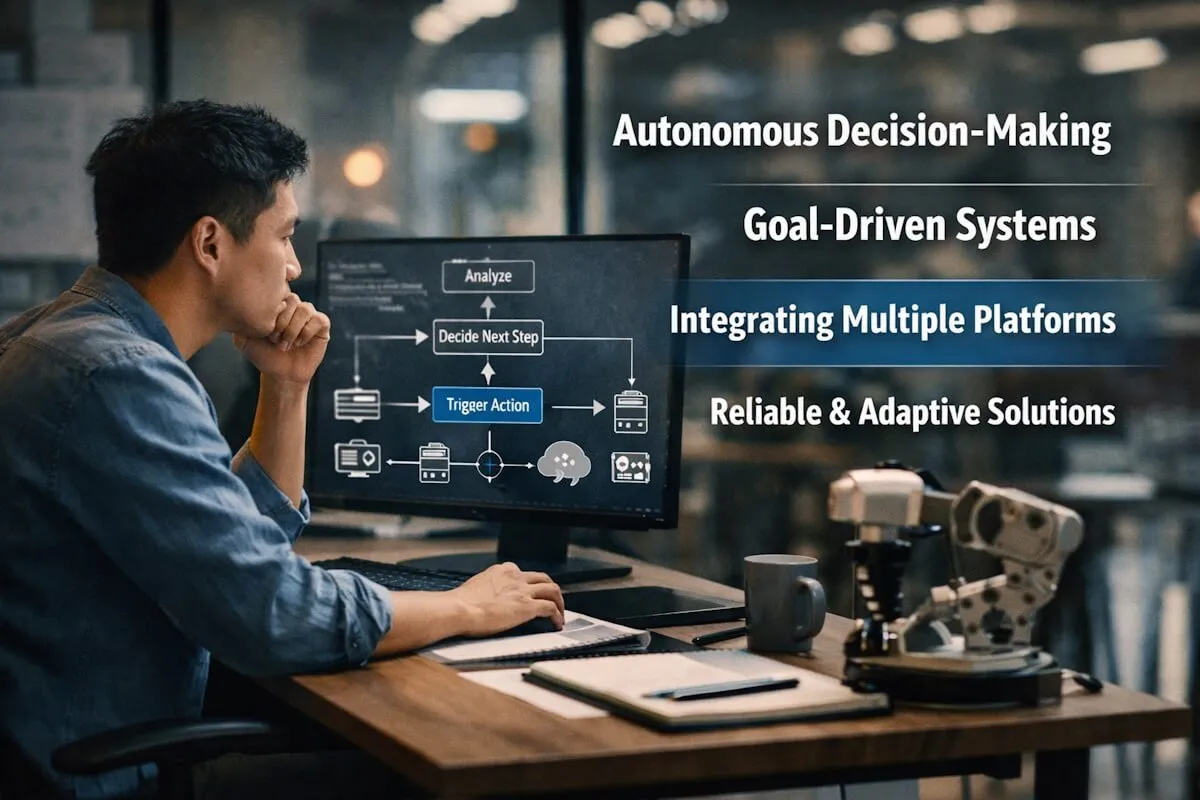
The demand for AI talent isn’t new. But the kind of talent businesses need is changing fast.
It’s no longer enough to build models or write scripts that respond to prompts. Companies now want systems that can take action, make decisions, and keep processes moving without constant input.
That’s where agentic AI engineers come in.
If you’re hiring, building a team, or even thinking about stepping into this space yourself, you need to know what actually sets these engineers apart.
Let’s get into it.
It’s not just about coding anymore
Sure, coding still matters. But it’s not the main differentiator.
A lot of developers can write clean code. Fewer can design systems that act independently without breaking things.
Agentic AI engineers think beyond functions and APIs. They focus on how systems behave over time.
They ask:
- What happens after the first action?
- How does the system respond to unexpected inputs?
- When should it stop or escalate?
It’s less about writing instructions and more about designing behavior.
Strong understanding of goal-driven systems
This is the foundation.
Agentic systems don’t operate on fixed commands. They operate on goals.
That means engineers need to:
- Translate business goals into clear system objectives
- Break those objectives into executable steps
- Define success and failure conditions
Sounds simple, but it’s not.
If the goal is vague, the system becomes unreliable.
Top engineers know how to remove that ambiguity.
They don’t just ask “what should this system do?”
They ask “what outcome are we aiming for, and how will we measure it?”
Decision flow design is a core skill
Here’s where things get interesting.
Agentic systems constantly make decisions.
Should it proceed? Should it wait? Should it try a different approach?
These decisions need structure.
Engineers must design:
- Conditional logic that adapts to different scenarios
- Fallback paths when things don’t go as expected
- Escalation triggers for human intervention
This is not basic if-else logic.
It’s layered decision-making that evolves based on context.
And when done right, it feels almost natural in how the system behaves.
Ability to connect multiple systems
Agentic AI doesn’t live in isolation.
It interacts with:
- CRMs
- Databases
- Communication tools
- Internal dashboards
So engineers need to be comfortable connecting different systems.
Not just technically, but logically.
They need to ensure:
- Data flows correctly
- Actions trigger the right responses
- Dependencies don’t break execution
This is where many projects fail.
It’s not the intelligence part. It’s the connections.
Focus on reliability over experimentation
A lot of AI work in the past was experimental.
Try something. See what happens. Iterate.
That mindset doesn’t fully work here.
Agentic systems are tied to real business operations.
They handle tasks that affect customers, revenue, and internal workflows.
So reliability becomes critical.
Top engineers prioritize:
- Predictable behavior
- Error handling
- System stability over time
They don’t chase flashy outputs. They build systems that quietly work without issues.
Continuous improvement mindset
Even the best-designed systems won’t be perfect from day one.
They need to learn from outcomes.
Engineers should:
- Track system performance
- Identify weak points
- Adjust logic based on real usage
This is not a one-time build.
It’s an ongoing process.
And the engineers who understand this tend to build systems that actually improve over time.
Clear communication with non-technical teams
This skill often gets overlooked.
Agentic AI engineers don’t work in isolation. They work with product managers, business teams, and stakeholders.
They need to:
- Explain how the system works in simple terms
- Set realistic expectations
- Translate business needs into technical plans
If communication breaks down, the entire project suffers.
Top engineers bridge that gap.
They don’t hide behind technical language. They make things understandable.
Knowing when not to automate
Here’s a surprising one.
Not everything should be automated.
Some decisions need human judgment. Some processes are too complex or sensitive.
Good engineers recognize this.
They know where to:
- Introduce automation
- Keep human control
- Balance both effectively
This prevents over-engineering and reduces risk.
Why hiring the right talent matters
If you’re building agentic systems, your team defines the outcome.
The difference between a working system and a frustrating one often comes down to the people behind it.
That’s why many businesses look for specialized Agentic AI Development Services instead of trying to figure everything out internally.
It gives them access to engineers who already understand these systems.
What to look for when you hire
If you’re planning to build your own team, here’s what you should focus on.
When you Hire AI Agent Developers, look beyond resumes.
Pay attention to:
- How they approach problem-solving
- How they design workflows
- How they handle edge cases
- How they explain their thinking
Ask them real-world scenarios.
See how they think, not just what they know.
The shift in expectations for 2026
The bar is getting higher.
In the past, building a working model was enough.
Now, businesses expect:
- Systems that run independently
- Minimal manual intervention
- Consistent performance
- Easy scalability
This changes what “good” looks like.
Engineers who adapt to this shift will stand out.
Others may struggle to keep up.
Industries driving demand for these skills
Some sectors are pushing this demand faster than others.
SaaS
Automation across user journeys is becoming standard.
E-commerce
From order management to customer interaction, execution is getting smarter.
Finance
Monitoring, reporting, and compliance tasks are being handled with less manual input.
Healthcare
Scheduling and coordination tasks are becoming more streamlined.
But honestly, this demand is spreading everywhere.
Any business that wants faster execution will need these skills.
A quick reality check
Not every developer needs to become an agentic AI expert.
But if you’re working on systems that interact with real-world processes, these skills are becoming hard to ignore.
The shift is already happening.
Slowly, but steadily.
So, what should you do next?
If you’re a business leader:
Start evaluating your current team. Do they have these skills? If not, where are the gaps?
If you’re a developer:
Start building systems that go beyond prompts. Focus on behavior, not just outputs.
If you’re somewhere in between:
Stay aware. This space is moving, and it’s not slowing down.
The bigger takeaway
Agentic AI is not just changing tools. It’s changing expectations.
The engineers who succeed in this space are not just builders.
They are designers of how systems act, respond, and evolve.
And as businesses rely more on these systems, the demand for this kind of thinking will only grow.
So the real question is simple.
Are you building systems that wait for instructions, or systems that know what to do next?